
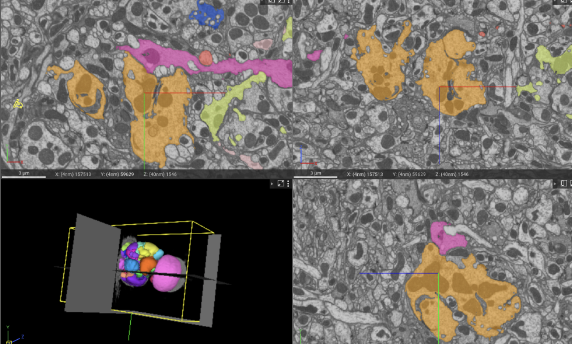
At The Polus Center for Data Research (PCDR) , we are advancing a future where biomedical discovery is accelerated through open, interoperable, and high-performing data systems. As stewards of a collaborative research ecosystem, we support the development of AI-driven tools, standardized workflows, and open-source platforms that enable scientists to work smarter, faster, and more collaboratively. Our mission is to empower the biomedical community with the infrastructure, training, and technologies needed to unlock new knowledge and drive collective progress.
The Polus Center for Data Research
Leading with Vision and Expertise

Center Director
Nathan Hotaling, PhD
Dr. Nathan Hotaling has nearly two decades of experience in biomedical research and data science. He leads a team of more than 80 data professionals who build and run systems for reproducible research and secure data handling in government contracting and consulting. His groups support large-scale biomedical data analysis, including studies that rely on data sets measuring hundreds of terabytes in size.
In partnership with the National Institutes of Health, Hotaling oversaw development of the Polus Platform, an open-source system that runs on cloud and high-performance computing. The platform combines artificial intelligence, statistical methods, reproducible and traceable workflows, and tools for interactive data exploration in one environment.
Hotaling has also assembled teams in clinical and microscopy image analysis, real-world evidence pharmacoepidemiology, cheminformatics, molecular modeling, and multiple omics fields. Their work focuses on data quality, harmonization, and hypothesis-driven discovery across conditions that include COVID-19 and cancer.
Dr. Hotaling recognized that the incredibly useful tools, platforms, and processes set up by his teams needed to reach a wider audience. Through the Polus Center for Data Research at NGRF, he is making the platform and related practices available as open-source resources for biomedical researchers worldwide and hopes to foster a community around these tools.
Professional and Research Background Before PCDR
Before starting PCDR, his professional journey included postdoctoral research at the National Eye Institute (NEI) and the National Institute of Standards and Technology (NIST). There, he focused on developing deep learning algorithms and pipelines to analyze cell therapy tissues and optimize nanofiber scaffolds for regenerative medicine. This work is part of the quality control pipeline for a Phase I clinical trial using autologous induced pluripotent stem cells to treat patients with macular degeneration, which is the first of its kind in the US.
His earlier academic background includes a PhD in Biomedical Engineering from Georgia Tech and a Master of Science in Clinical Research from Emory University, where he studied immune responses to carbohydrates presented from biomaterial surfaces and developed statistical models to understand various systems from clinical to educational. This diverse research experience equipped him with a solid foundation in translational science, computational modeling, and data analytics, which he brings to his work at NGRF.

Director of Research Technologies
Benjamin Blum, PhD
Benjamin Blum is Director of Research Technologies at Novagen Research Fund. Ben comes to NGRF from a series of biotech startups where he held roles of increasing responsibility, building and leading machine learning and data science platforms to develop novel protein, small molecule, and gene therapy programs in oncology and immunology. Along the way, he has led data analysis for projects in cancer, neuroscience, and infectious disease, resulting in several publications in leading journals and multiple patents. Ben also has experience in early stage tech startups, building and scaling teams, processes, and infrastructure.
-
Blum B, Hekman R, Hume A, Goel R ...
Actionable Cytopathogenic Host Responses of Human Alveolar Type 2 Cells to SARS-CoV-2
Molecular Cell, 2020; 80, 1104-1122.e9
-
Benjamin C. Blum, Andrew Emili
Bioinformatics Advances, Volume 1, Issue 1, 2021, vbab024, https://doi.org/10.1093/bioadv/vbab024
Published:
21 September 2021
PCDR Mission: To accelerate biomedical research using Artificial Intelligence & other novel technologies. PCDR fosters an open-source community & supports interoperable platforms, applications, tools, training, & data while increasing the aggregate rate of scientific advancement.
PCDR Vision: To move Biomedical research forward more quickly. We envision a future in which data, workflows, analysis, standards, & tools can be seamlessly utilized, exchanged, & scaled to empower scientists at every level to speed research, discovery, & knowledge generation.
About Us
At PCDR, we provide a powerful ecosystem of tools and platforms that accelerate biomedical discovery through data-driven research and open collaboration. Our core capabilities include:
Performant data processing tools that utilize standards - https://github.com/PolusAI/bfio & https://github.com/PolusAI/filepattern
Across a diverse set of data types PCDR's library of tools provide scalable and interoperable processing steps that follow and utilize standards.
Scalable Open Data Processing Pipelines - https://github.com/PolusAI/mm-workflows & https://github.com/PolusAI/image-workflows
Packaging and implementations of open source tools, algorithms, models, and approaches to maximize insight and speed.
PCDR also supports the development of standards to enable enhanced collaboration and interoperability across scientific communities:
MicroJSON file specification - https://github.com/PolusAI/microjson
A filetype agnostic (despite its name!) specification for microscopy image annotation helps to improve interoperability while also solving data provenance, scale, and performant data loading challenges.
Sophios - https://github.com/PolusAI/sophios
Open standards for workflow definitions (Common Workflow Language - CWL) are critical to enable reproducibility in data processing. However, writing these workflows can be time consuming and difficult. Thus, we created Sophios to dramatically simplify the creation of CWL and infer connections in workflows to reduce errors, save time, and speed up research.
Dr. Hotaling’s Selected Publications
-
Schaub, N. J., and Hotaling, N., “Assessing Efficiency in Artificial Neural Networks,” Applied Sciences, Vol. 13, No. 18, 2023, p. 10286. https://doi.org/10.3390/app131810286.
-
Moore, J., et al. “OME-Zarr: A Cloud-Optimized Bioimaging File Format with International Community Support,” Histochemistry and Cell Biology, 2023. https://doi.org/10.1007/s00418-023-02209-1.
-
Ishaq, N., Hotaling, N., and Schaub, N., “Theia: Bleed-Through Estimation With Convolutional Neural Networks,” presented at the Proceedings of the IEEE/CVF Conference on Computer Vision and Pattern Recognition, 2023. https://doi.org/10.1109/CVPRW59228.2023.00447.
-
Goyal, V., Schaub, N. J., Voss, T. C., and Hotaling, N., “Unbiased Image Segmentation Assessment Toolkit for Quantitative Differentiation of State-of-the-Art Algorithms and Pipelines,” BMC Bioinformatics, Vol. 24, No. 1, 2023, p. 388. https://doi.org/10.1186/s12859-023-05486-8.
-
Florczyk, S., Hotaling, N., Simon, M., Chalfoun, J., Horenberg, A., Schaub, N., Wang, D., Szczypiński, P., DeFelice, V., Bajcsy, P., and Simon, C. “Measuring Dimensionality of Cell-Scaffold Contacts of Primary Human Bone Marrow Stromal Cells Cultured on Electrospun Fiber Scaffolds.” Journal of Biomedical Materials Research. Part A, 2022. https://doi.org/10.1002/jbm.a.37449.
-
Silva, T. D., Hotaling, N., Chew, E. Y., and Cukras, C. Feature-Based Retinal Image Registration for Longitudinal Analysis of Patients with Age-Related Macular Degeneration. In Medical Imaging 2020: Image Processing, No. 11313, 2020, pp. 113132Z.https://doi.org/10.1117/12.2549969.
-
Schaub, N. J.*, Hotaling, N.*, Manescu, P., Padi, S., Wan, Q., Sharma, R., George, A., Chalfoun, J., Simon, M., Ouladi, M., Carl G. Simon, J., Bajcsy, P., and Bharti, K. “Deep Learning Predicts Function of Live Retinal Pigment Epithelium from Quantitative Microscopy.” The Journal of Clinical Investigation, Vol. 2, No. 130, 2019, pp. 1010–1023. https://doi.org/10.1172/JCI131187.
-
Hotaling, N. A., Khristov, V., Wan, Q., Sharma, R., Jha, B. S., Lotfi, M., Maminishkis, A., Simon, C. G., and Bharti, K. “Nanofiber Scaffold-Based Tissue-Engineered Retinal Pigment Epithelium to Treat Degenerative Eye Diseases.” Journal of Ocular Pharmacology and Therapeutics, Vol. 32, No. 5, 2016, pp. 272–285.https://doi.org/10.1089/jop.2015.0157.
-
Hotaling, N. A., Bharti, K., Kriel, H., and Simon Jr., C. G. “DiameterJ: A Validated Open Source Nanofiber Diameter Measurement Tool.” Biomaterials, Vol. 61, 2015, pp. 327–338. https://doi.org/10.1016/j.biomaterials.2015.05.015.